
This week in #52ancestors the theme is Adventure and I decided to write about the farthest flung family on my tree: the Negus family. The Negus line hangs off the Van Syckel line in Hunterdon County, New Jersey as one of Aaron Van Syckel’s grandchildren (by Daniel (1790-1861)) Isabella Van Syckel married James Engle Negus of Philadelphia.
 James Engle Negus (1809-1884) starts out in Philadelphia where he is a wealthy merchant and chief weight clerk at the U. S. Mint in Philadelphia. However, in June of 1854, Negus is exposed for short weighting gold at the Mint. He made immediate restitution (for tens of thousands of dollars, if the newspapers are to be believed) and flees with his family to England. He later returns to the US and settles with his mother Susan, his wife Isabella and daughter Susan Engle in Somerset County, New Jersey where he owned a great deal of farmland. This may explain why I cannot find the family in the 1860 Census, and then find them in Franklin township, Somerset, NJ in 1870. James apparently saw the error of his ways, as he becomes a successful gentleman farmer in Franklin. His mother dies there, as do Isabella and Susan.
James Engle Negus and Isabella Van Syckel Negus have four children: Robert Patterson Negus (1838-1884), Susan Engle Negus (1840-1915), James Engle Negus (1842-1903) and William Shippen Negus (1844-1914). William S. Negus appears to have been in finance. James E. Negus served with distinction in the Civil War and settled in Greenville, Mississippi where he was a banker. Susan Engle Negus never married but was active in many women’s organizations including the DAR. Robert Patterson Negus is the traveler and the one who caught my eye when the topic of adventure came up.

Robert Patterson Negus (1838-1884) was born and raised in Philadelphia. I have seen mention of his education in Europe as an engineer. He may have gotten the travel bug as the family flitted about England and Wales. He was in New Zealand in 1863 when he married Mary Ann Hargrave (1838-1881), daughter of Captain William Hargrave of Sandridge. They had seven children:
- Mary Ann Isabella Negus (1864-1950) married David James Bardwell Smith
- Susan Engle Emiline Negus (1866)
- Charlotte Ernestine Negus (1868-1949) married Edward V. French
- William James Hargrave Negus (1871)
- Selinda Parry Negus (1872-1959) married twice
- Horatio Van Syckel Negus (1874-1966)
- Virginia Louise Negus (1876-1956)
However, neither Robert nor Mary Ann Negus would live to see their 45th birthday. Mary Ann died in 1881 and Robert died 2 October 1884. This tragedy meant that four of the seven children needed a new home. Mary Ann Isabella Negus, while the eldest, could not take on the raising of her siblings. She married shortly after her father’s death, and was possibly courting David Smith when all this was going on. Courtship of a young woman is one thing, taking on a ready made family quite another. In any case, the four younger siblings are sent back to America to live with their grandmother Isabella VS Negus and aunt Susan Engle Negus.

Interesting side note: the guardianship proceedings distinguish between Charlotte who is over 14 and the three children under 14. Each is noted as having about $500 to their name. James Engle Negus seems to have helped manage some of these proceedings but by my reckoning he is settled in Mississippi at this time with a wife and three children. However, William Shippen Negus appears to have settled in Bound Brook and so he may also have been involved in retrieving the children. Possibly their adventure was travelling by steamer across the world without an adult!
This line represents a fascinating side trip and I want to thank cousin Melanie Ealey for bringing it to my attention. Her email to me was exactly what I was hoping would happen when I started this blog!


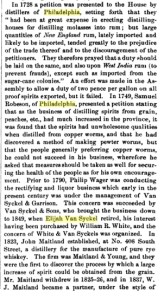 Elijah appears to have established his grocery and then expanded it to sell liquor. He then gave up the grocery business and solely sold wine and liquor. He appears in city directories and merchant listings fairly continuously from 1818 until 1850. During the 1830’s he was in business with John Garrison but in 1835 this is dissolved and Elijah continues on alone, eventually adding his sons to the concern. One curious discovery: in 1824, Elijah was granted relief from the US government because three hundred and fifty-two cases of sugar were destroyed in a fire in 1822, upon which $4217 in duties were due. Elijah apparently appealed for aid in paying the duties as the sugar had not been insured.
 He also appears to have been active in local politics as he has an unsuccessful bid for election to the Common Council in Philadelphia in 1827. In 1839 he is appointed to a committee to examine and report on the state of the Schuylkill Bank.
 Samuel married twice. He married Lydia H. Bishop (1828-1860) on 7 March 1849 but they had no children. They are enumerated in Philadelphia in the 1850 Census along with several of Samuel’s siblings: Mary B Jones Tobey and husband Samuel, Harriet Jones. Samuel is listed with the occupation of merchant. By 1860, the family has relocated to Burlington County, where Samuel and Lydia maintain a household that contains most of her family: Nathanial Bishop (cultivator of cranberries) and Harriet Bishop. Samuel’s occupation is “manufacturing” and his personal worth is $50,000.
 Then he married Eliza Catherine Jacob (1835-1864) on 1 May 1862. They had one child, a son named Samuel Howell Jones (1862-1894). Sadly, “Kate” died in 1864. I do not know what took him to Kentucky but I strongly suspect that it might have something to do with all the Louisville & Nashville Railroad stock in his estate accounts. Either Samuel was an investor or he was diversifying the family assets out of iron pipes to iron rails. A review of the family archive at the Historical Society of Pennsylvania will be necessary to complete this chapter.


![Jones_Benjamin_W_business_Trenton_State_Gazette_1858-05-07_[2]](https://tellingmystory.blog/wp-content/uploads/2018/03/jones_benjamin_w_business_trenton_state_gazette_1858-05-07_2.png?w=300&h=265) I do not know much about Benjamin W. Jones’ business enterprises. In the 1850 Census, he is listed in Philadelphia as a merchant with $15,000 in real estate. He then appears in business with Richard Jones at Florence but that business dissolved in 1858. In the 1860 Census, the family is living near Richard Jones in Mansfield, Burlington County, New Jersey and his occupation is listed as founder. By 1870, Benjamin, Harriet and Ellen are living in Trenton, where his occupation is listed as none, with no real estate or personal property valued. However, Harriet does possess $10,000 in real estate and persona”l property valued at $25,000. In the 1880 Census, Benjamin is listed with Harriet and both children, and while his occupation is listed as travelling salesman, there is a check mark in the box marked “is the person sick or temporarily disabled so as to be unable to attend to ordinary business or duties.”
I do not know much about Benjamin W. Jones’ business enterprises. In the 1850 Census, he is listed in Philadelphia as a merchant with $15,000 in real estate. He then appears in business with Richard Jones at Florence but that business dissolved in 1858. In the 1860 Census, the family is living near Richard Jones in Mansfield, Burlington County, New Jersey and his occupation is listed as founder. By 1870, Benjamin, Harriet and Ellen are living in Trenton, where his occupation is listed as none, with no real estate or personal property valued. However, Harriet does possess $10,000 in real estate and persona”l property valued at $25,000. In the 1880 Census, Benjamin is listed with Harriet and both children, and while his occupation is listed as travelling salesman, there is a check mark in the box marked “is the person sick or temporarily disabled so as to be unable to attend to ordinary business or duties.”
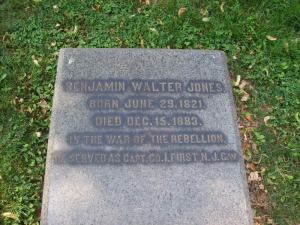 Benjamin Walter Jones died 15 December 1883 in Philadelphia and is buried at Laurel Hill Cemetery in Philadelphia. His death notice in the Philadelphia Inquirer notes that his brother hosted the funeral at his home at 1818 Delancey Place. He left no will, which is not a surprise as his wife Harriet appears to have owned everything.
 Joseph Roach is listed in records as a merchant, but I can find little to document what and where he did business.

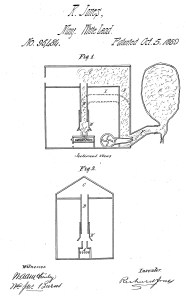 Although Richard appears to have gone to work early in the family foundry business at Hanover, NJ, he also seems to have been interested in diversifying the family holdings. He and his brother Samuel Howell Jones established and dissolved several businesses in Hanover, Florence and Trenton between 1845 and 1870. The pipes used in the Boston Water Works in 1847 came from Hanover Furnace. In 1850 Richard was a principle in the New Jersey Exploring and Mining Company. He established the New Jersey Zinc Paint Company, most likely as a result of his experiments with and eventual patents on zinc oxide extraction (1854 and 1869). Richard was definitely something of a chemical genius but I am not sure about his business expertise. The iron industry in the 19th century was a risky business. with many smaller operations failing due to pressures of the economy and production expenses.
 Telling My Story