
This week in #52ancestors the theme is Adventure and I decided to write about the farthest flung family on my tree: the Negus family. The Negus line hangs off the Van Syckel line in Hunterdon County, New Jersey as one of Aaron Van Syckel’s grandchildren (by Daniel (1790-1861)) Isabella Van Syckel married James Engle Negus of Philadelphia.
 James Engle Negus (1809-1884) starts out in Philadelphia where he is a wealthy merchant and chief weight clerk at the U. S. Mint in Philadelphia. However, in June of 1854, Negus is exposed for short weighting gold at the Mint. He made immediate restitution (for tens of thousands of dollars, if the newspapers are to be believed) and flees with his family to England. He later returns to the US and settles with his mother Susan, his wife Isabella and daughter Susan Engle in Somerset County, New Jersey where he owned a great deal of farmland. This may explain why I cannot find the family in the 1860 Census, and then find them in Franklin township, Somerset, NJ in 1870. James apparently saw the error of his ways, as he becomes a successful gentleman farmer in Franklin. His mother dies there, as do Isabella and Susan.
James Engle Negus and Isabella Van Syckel Negus have four children: Robert Patterson Negus (1838-1884), Susan Engle Negus (1840-1915), James Engle Negus (1842-1903) and William Shippen Negus (1844-1914). William S. Negus appears to have been in finance. James E. Negus served with distinction in the Civil War and settled in Greenville, Mississippi where he was a banker. Susan Engle Negus never married but was active in many women’s organizations including the DAR. Robert Patterson Negus is the traveler and the one who caught my eye when the topic of adventure came up.

Robert Patterson Negus (1838-1884) was born and raised in Philadelphia. I have seen mention of his education in Europe as an engineer. He may have gotten the travel bug as the family flitted about England and Wales. He was in New Zealand in 1863 when he married Mary Ann Hargrave (1838-1881), daughter of Captain William Hargrave of Sandridge. They had seven children:
- Mary Ann Isabella Negus (1864-1950) married David James Bardwell Smith
- Susan Engle Emiline Negus (1866)
- Charlotte Ernestine Negus (1868-1949) married Edward V. French
- William James Hargrave Negus (1871)
- Selinda Parry Negus (1872-1959) married twice
- Horatio Van Syckel Negus (1874-1966)
- Virginia Louise Negus (1876-1956)
However, neither Robert nor Mary Ann Negus would live to see their 45th birthday. Mary Ann died in 1881 and Robert died 2 October 1884. This tragedy meant that four of the seven children needed a new home. Mary Ann Isabella Negus, while the eldest, could not take on the raising of her siblings. She married shortly after her father’s death, and was possibly courting David Smith when all this was going on. Courtship of a young woman is one thing, taking on a ready made family quite another. In any case, the four younger siblings are sent back to America to live with their grandmother Isabella VS Negus and aunt Susan Engle Negus.

Interesting side note: the guardianship proceedings distinguish between Charlotte who is over 14 and the three children under 14. Each is noted as having about $500 to their name. James Engle Negus seems to have helped manage some of these proceedings but by my reckoning he is settled in Mississippi at this time with a wife and three children. However, William Shippen Negus appears to have settled in Bound Brook and so he may also have been involved in retrieving the children. Possibly their adventure was travelling by steamer across the world without an adult!
This line represents a fascinating side trip and I want to thank cousin Melanie Ealey for bringing it to my attention. Her email to me was exactly what I was hoping would happen when I started this blog!
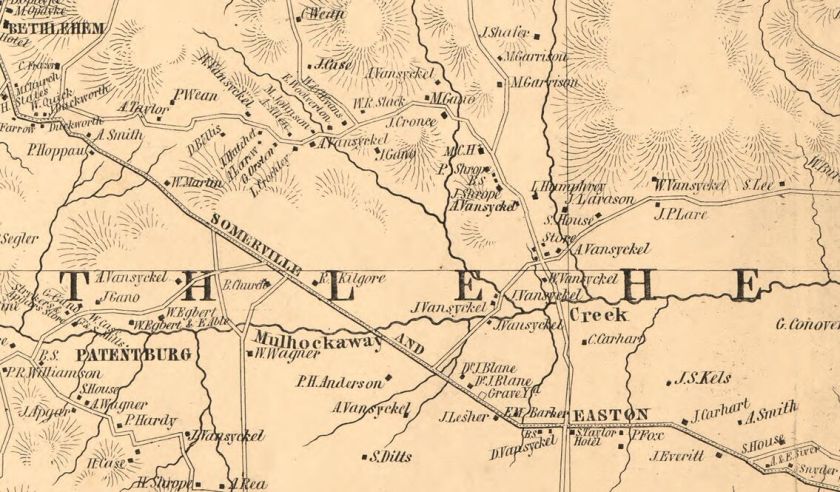


 On 16 June 1842, Joseph Van Syckel married Catherine I. Smith (1823-1855), with whom he had three children: John Van Syckel (1843-1879), Helen Van Syckel (1849-1851) and Mary Van Syckel (1851-? died young?). After Catherine’s death, Joseph married Cyrena Martin (1830-1901) with whom he had two children: Frank Van Syckel (1859-1864) and Kate Van Syckel (1860-1943).
 Mercy Van Syckel was born 14 April 1820, the oldest daughter of Aaron Van Syckel and Mary Bird Van Syckel. She married Samuel C. Dilley (1827-1852) in 1846 in Hunterdon County. She had one son by Samuel,

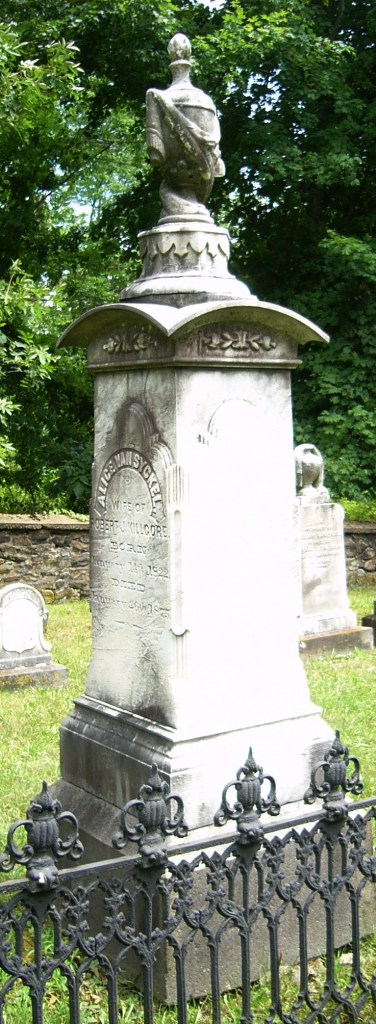
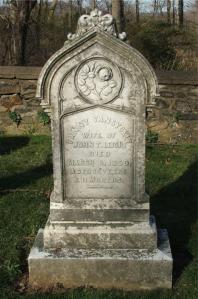
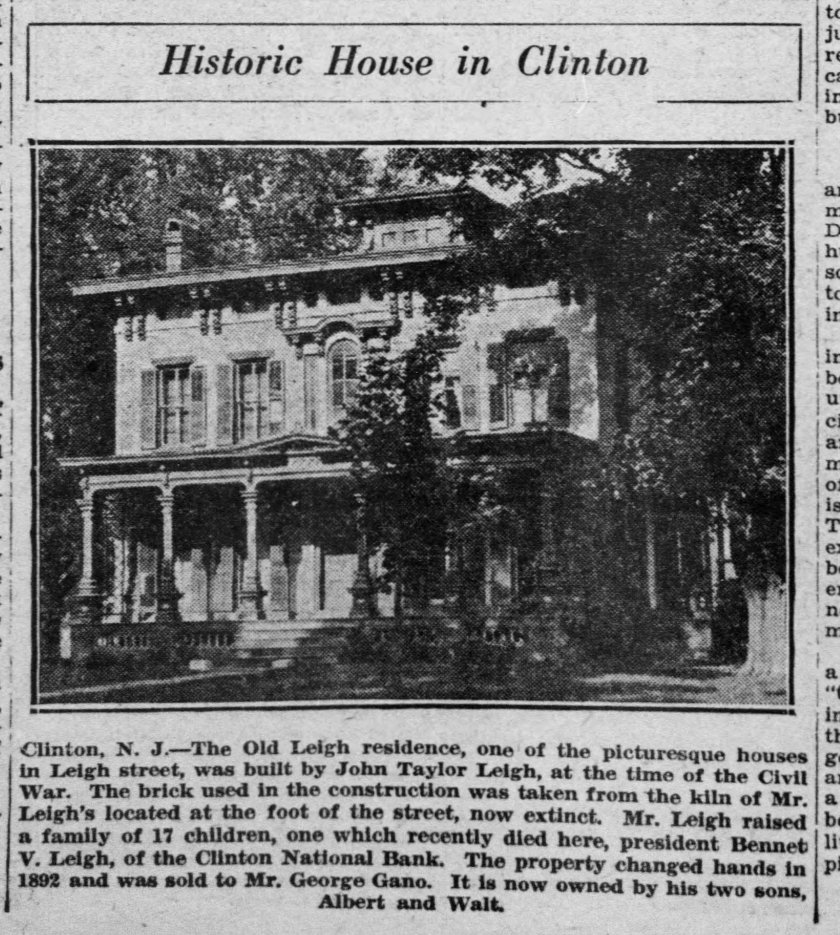
 Sylvester Van Syckel was the fifth child of Aaron Van Syckel and Mary Bird Van Syckel. He was born 21 February 1826, most likely in Union township, Hunterdon County, New Jersey. Like his other male siblings, Sylvester was well educated and eventually made his way to the College of New Jersey (later Princeton University), graduating with a BA in 1846. He then went on to study medicine at New York University and worked at Bellevue Hospital. He graduated from NYU in 1849 and by 1850 he was back in Clinton, New Jersey establishing a medical practice. Interestingly enough the medical association noted him as an allopath, which apparently means that he practiced traditional medicine rather than homeopathy.
 In 1868 the family moved into the home on Center St. that remained in the family for forty years. Sylvester died in 1906 and his widow appears to have gone to live with William and his wife Elizabeth who had taken over the Carhart family farm outside of Clinton. Mary Van Syckel died 20 February 1917. Both Sylvester and Mary Van Syckel are buried in Riverside Cemetery in Clinton.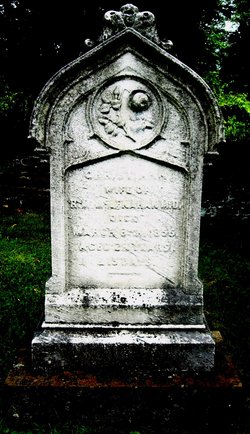
 Bennet Van Syckel was born 17 April 1830 to Aaron Van Syckel and Mary Bird Van Syckel of Hunterdon County, New Jersey. He was something of a prodigy, entering Princeton at thirteen and graduating three years later with high honors. He then studied law under Alexander Wurts, of Flemington, but he was forced to wait to take the bar exam due to his being under 21 by some years. He practiced law in Flemington until 1858, when Governor Theodore Fitz Randolph appointed him to the New Jersey Supreme Court. At that time the Supreme Court was still a circuit court and Bennet covered Salem, Cumberland, Atlantic and Cape May, and I would be jealous of his shore time except I am pretty sure he was traveling by horse. When the districts were readjusted, he took over Union and Ocean counties. He was reappointed five times, retiring from the court in 1904 due to poor health. One of the more significant opinions he delivered had to do with race track gambling and this lead to a change in the state constitution.
 I don’t know whether complications from the birth of Charles lead to Emily’s death on 4 November 1864 but I think it likely there is a connection. Six children in eleven years in the mid 19th century would be a strain on anyone. She is buried in Bethlehem Baptist Cemetery in Pattenburg, NJ, along with Charles.
 Telling My Story