
The nineteenth century is my comfort zone. I can read the handwriting. I know the records one can use to track people in places from state to state. The colonial period, not so much. I end up using a lot of printed materials as the original records are not always available in digital form. And I like manuscripts. I like originals. I don’t always trust the extent of the transcriptions. Also the place names changed as the American colonies became states with counties and townships. It makes the whole search more complicated but it can also be fun. You discover new types of documents, you have to analyse data differently.
Take Joshua Opdyke, for instance. He was the father of Catherine Opdyke, who married Aaron Van Syckel (1764-1838). He was born about 1713 and died in 1789, just as America was becoming, well, America. He was a farmer in Kingwood township in what is now Hunterdon County, New Jersey. What can I learn about his life, his family and his impact on his community?

Joshua Opdyke was the second son of Albert Opdyke. He married Ann Green (1717-) of Hunterdon in 1738. Between 1743 and 1774 he amassed considerable land holdings in and around Hunterdon County, in addition to the 298 acres he acquired from his wife’s father. The year he died, at the age of 76, he was a delegate to the Baptist Convention in Philadelphia. Apparently his father Albert Opdyke (1685-1752) broke with family tradition and became a Baptist.
Joshua and Ann Opdyke have a number of children:
- Richard Opdyke (1740-1825)
- Luther Opdyke (1750-1838)
- Sarah Opdyke (175?-?)
- Elizabeth Opdyke (175?-?)
- Margaret Opdyke (175?-?)
- Frances Opdyke (1757-1809)
- Hannah Opdyke (1760-1821)
- Catherine Opdyke (1762-1851)
Much of this information I found in published books such as The Op Dyck Genealogy by Charles Wilson Opdyke and the Genealogical and Family History of Central New York by William R. Cutter. And some of the information in one source conflicted with information in another. Was Joshua the son or grandson of Albert? Was Joshua born in New York like his father or in Hunterdon County. My heart yearns for bible records, correspondence, and really anything with his signature or written in his hand. Yes, I know the assumption of literacy in the 18th century is dicey but still. The closest I have come is his will record.
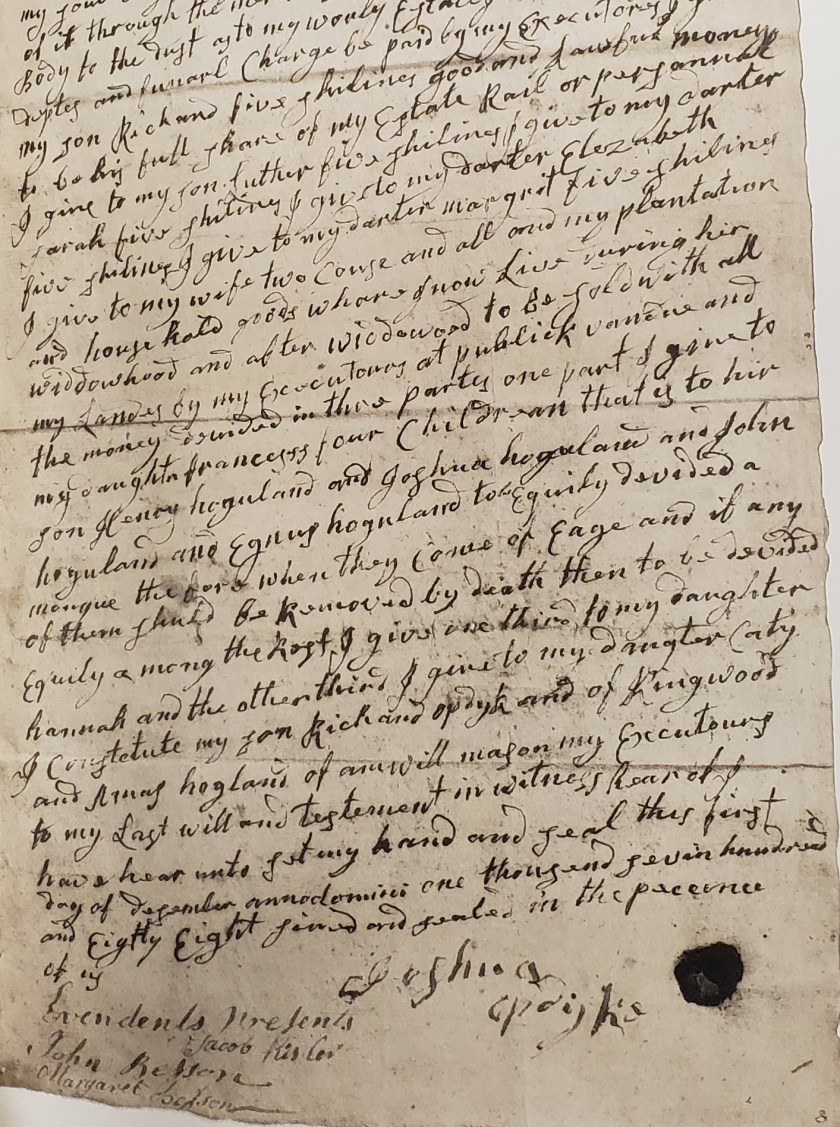
I did find church records of a Baptist church in Bethlehem, near Kingwood. They mention Joshua as someone trusted enough to write letters of dismissal and to represent the community in various ways. But his relationship with the church was apparently contentious, as I find him being censured in 1772 for criticizing the preacher and, being unrepentant, he was excluded from the meeting. He was reinstated in 1787 but his death is noted two years later on 28 February 1789.

 Do you have a county boundary nemesis? I do, in the form of New Jersey. I have yet to come up with a one stop way to figure out where the Windsor townships are in any given year. Legally, I know that Windsor Township split into East and West Windsor on 9 February 1797 while these were in Middlesex County. The townships were incorporated in 1798 and their boundaries changed when Hightstown borough formed in 1853 and Washington Township formed in 1860.
 The three living children are mentioned in Hiram’s Monmouth County 1845 will and there is a clue there about how this Monmouth County family came to be in Mercer County. Hiram divides his land holdings between his two sons, mentioning that he leaves Thomas the “plantation or farm” in which he currently lives. I matched that with a house history I uncovered in doing Thomas H. Mount’s essay and Voila!
 James Engle Negus (1809-1884) starts out in Philadelphia where he is a wealthy merchant and chief weight clerk at the U. S. Mint in Philadelphia. However, in June of 1854, Negus is exposed for short weighting gold at the Mint. He made immediate restitution (for tens of thousands of dollars, if the newspapers are to be believed) and flees with his family to England. He later returns to the US and settles with his mother Susan, his wife Isabella and daughter Susan Engle in Somerset County, New Jersey where he owned a great deal of farmland. This may explain why I cannot find the family in the 1860 Census, and then find them in Franklin township, Somerset, NJ in 1870. James apparently saw the error of his ways, as he becomes a successful gentleman farmer in Franklin. His mother dies there, as do Isabella and Susan.




 On 16 June 1842, Joseph Van Syckel married Catherine I. Smith (1823-1855), with whom he had three children: John Van Syckel (1843-1879), Helen Van Syckel (1849-1851) and Mary Van Syckel (1851-? died young?). After Catherine’s death, Joseph married Cyrena Martin (1830-1901) with whom he had two children: Frank Van Syckel (1859-1864) and Kate Van Syckel (1860-1943).
 Mercy Van Syckel was born 14 April 1820, the oldest daughter of Aaron Van Syckel and Mary Bird Van Syckel. She married Samuel C. Dilley (1827-1852) in 1846 in Hunterdon County. She had one son by Samuel,

 Telling My Story