
 This week in #52ancestors I celebrate the man who left New York for New Jersey and made it possible for me to spend every spring break of my childhood shopping at the Short Hills Mall. And the theme for Week 36 is “Work” which I am going to interpret as “creating the family business.” I still have wooden Smooth On crates in my house which are so useful for so many storage needs.
This is yet another story with a lot of questions, but here is what I have:
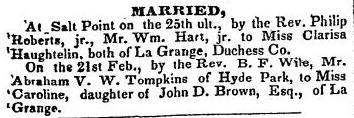
Samuel Dusenbury Tompkins was born 12 Dec 1838 in Hyde Park, NY. He was the oldest child of Abraham Van Wagenen (1816-1869) and Caroline Brown (1818-1878) Tompkins. They went on to have eight more children, which probably helped with the work on the small farm Abraham owned in Dutchess County. For several years I have been searching for corroboration of the marriage date of Abraham and Caroline. The family bible notes that the marriage occurred on 22 Feb 1839. This makes the date of birth of the first child in 1838 a bit sticky. Thank goodness for the New York State Historic Newspapers project! I found a marriage notice in the Poughkeepsie Eagle for 9 March 1838 which names all the right people and gives the marriage date as 21 Feb 1838.
Samuel’s obituary mentions that he came to Jersey City when he married Gettianna Vreeland, daughter of Nicholas and Elizabeth Van Riper Vreeland. They were married 2 January 1868 in Bergen, NJ at her parents’ residence by Rev. B. C. Taylor. The couple had seven children, five of whom lived to adulthood.
- Grace Elizabeth Tompkins (1869-1964)
- Vreeland Tompkins (1870-1956)
- Abraham Van Wagnen Tompkins (1870-1870)
- Samuel Edward Tompkins (1875-1876)
- James Haviland Tompkins (1877-1942)
- Emma Louise Tompkins (1881-1971)
- Harold Doremus Tompkins (1888-1951)
In fact, the couple lived with Nicholas Vreeland and family in Bergen for the first few years of their marriage. They are enumerated there in the 1870 Census and Samuel appears in Jersey City directories as early as 1872 with the occupation “storage.” This aligns with a newspaper article which describes the complete loss of a New York city warehouse in 1872, resulting in the loss of stored cotton, grain and tobacco. By 1876, Samuel is listed as a real estate broker, although the residence is still listed as Communipaw n Vreeland. In the 1880 Census, Samuel and family have been joined by brother James L Tompkins, down from Dutchess County, NY.
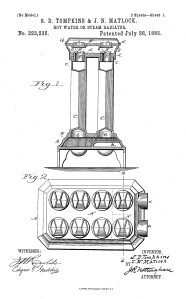 In 1895, Samuel founded the Smooth-On Manufacturing Company to manufacture a chemical iron compound by that name. I have always been told that Samuel was the businessman and backed the company with his own money and experience, while his son Vreeland was the chemist and the creator of Smooth-On. Evidence, however, indicates that he was involved in inventing and designing as early as 1885, as he was the one who filed for a patent for the design for a radiator in 1885 with John Matlock. And in 1905, his patent for a boiler patch states that he is the inventor. He is also listed in 1895 as the treasurer of the A. A. Griffins Iron Co. in Jersey City. Diverse holdings makes for good business.

Samuel Tompkins was active in the Bergen Reformed Church and was listed as deacon from 1912 to 1914. He was also a member of the Free and Accepted Masons Zeredatha Lodge No. 131. His grown children were active in Jersey City social events and he, as well as his daughters, entertained regularly according to the Jersey Journal.
Samuel D. Tompkins died at home on 1 January 1926. His funeral was held at his home, 533 Communipaw Ave. He was buried in the family plot of the burying ground opposite the Old Bergen Church. Later, due to the cemetery being demolished, the burials of Samuel and his wife Gettieanna were removed to Arlington Cemetery, in Kearny, NJ.

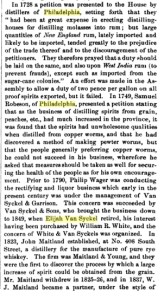 Elijah appears to have established his grocery and then expanded it to sell liquor. He then gave up the grocery business and solely sold wine and liquor. He appears in city directories and merchant listings fairly continuously from 1818 until 1850. During the 1830’s he was in business with John Garrison but in 1835 this is dissolved and Elijah continues on alone, eventually adding his sons to the concern. One curious discovery: in 1824, Elijah was granted relief from the US government because three hundred and fifty-two cases of sugar were destroyed in a fire in 1822, upon which $4217 in duties were due. Elijah apparently appealed for aid in paying the duties as the sugar had not been insured.
 He also appears to have been active in local politics as he has an unsuccessful bid for election to the Common Council in Philadelphia in 1827. In 1839 he is appointed to a committee to examine and report on the state of the Schuylkill Bank.

 Vreeland was educated at Public School No. 12 and the Hasbrouck Institute, in Jersey City. He graduated from Rutgers University in 1893 and was a member of Delta Phi fraternity. After graduation he was employed as a chemist at Standard Oil Co., Bergen Port Works. In 1895, he founded the Smooth-On Manufacturing Company, with his father serving as President and himself as lead chemist. Vreeland invented the product Smooth-On was an iron cement compound. I have a childhood memory of bookcases in our house and Louise Tompkins’ house which were made from the shipping containers from Smooth-On. After Samuel D. Tompkins’ death in 1926, Vreeland assumed the presidency until 1953 and then in retirement served as chairman of the board.
 I was fascinated to discover that Vreeland Tompkins’ obituary described him as a life-long Episcopalian, first at St. Paul’s Episcopal Church in Jersey City, then at Calvary Church in Summit and finally at St. Paul’s in Chatham, New Jersey. As one, myself, this gives me an extra connection to this interesting man.
 I grew up hearing stories about George Cornell Prince. Unfortunately, I did not ask the right questions of the people who knew him and I am left with a life story with a few holes in it. Perhaps one of my cousins will read this #52ancestors essay and can help fill in the blanks.
 So this is the first mystery: why did they pull up roots in Bradford County and move down to New Jersey? Philip is born there as are Edwin and Kathryn but the family does not appear in either the federal 1900 census or the 1905 New Jersey census. And yet, in a 1955 Camden Courier-Post article, George C. Prince is credited with forming the Prince Concrete Company in 1905.



 Samuel married twice. He married Lydia H. Bishop (1828-1860) on 7 March 1849 but they had no children. They are enumerated in Philadelphia in the 1850 Census along with several of Samuel’s siblings: Mary B Jones Tobey and husband Samuel, Harriet Jones. Samuel is listed with the occupation of merchant. By 1860, the family has relocated to Burlington County, where Samuel and Lydia maintain a household that contains most of her family: Nathanial Bishop (cultivator of cranberries) and Harriet Bishop. Samuel’s occupation is “manufacturing” and his personal worth is $50,000.
 Then he married Eliza Catherine Jacob (1835-1864) on 1 May 1862. They had one child, a son named Samuel Howell Jones (1862-1894). Sadly, “Kate” died in 1864. I do not know what took him to Kentucky but I strongly suspect that it might have something to do with all the Louisville & Nashville Railroad stock in his estate accounts. Either Samuel was an investor or he was diversifying the family assets out of iron pipes to iron rails. A review of the family archive at the Historical Society of Pennsylvania will be necessary to complete this chapter.


 Telling My Story