
 Last January 2018 I decided to try an experiment: from the birthday list generated by my RootsMagic program, I would make a list of ancestors and blog about one person per week for 52 weeks. I knew that I would have trouble following the schedule and topics outlined in Amy Johnson Crow’s 52 Ancestors in 52 Weeks. My job as well as various commitments would have derailed me if I had not been able to write the blogs ahead of time and schedule them to publish each week. But the weekly inspiration from those who were following Amy were really helpful and when I could I tagged my blog with her topic.

What I learned
- It is really hard to write 52 fully researched, carefully prepared, fully documented and illustrated essays. But that’s not the point of the exercise, so please keep reading.
- The birthday theme only goes so far. Some weeks I just gave up on finding the perfect match and just picked someone I thought interesting.
- My writing got boring. I found myself writing every post in chronological order: born, married, died, buried.
- I really resented having to stop researching and just start writing. I found myself saying “just one more source” way too often. When this happened I had to remind myself that this was not “the end.” I could always come back if I found more.
- Some ancestors just aren’t that interesting. “Lives of quiet desperation” aside, quite a few of my female ancestors, especially, just left me very little to work with.
- You really can write 300-700 words quite easily if you just start writing.
- You can have really interesting conversations with family members around what you got right and wrong (in their opinion) and learn new tidbits of information as you go.
What I want to do in 2019
- 52 weeks of family photographs. I am going to try to post a picture of a family member, group or dwelling place, write a short post identifying what I know and what I don’t.
- I am also going to try to go back to all the folks I passed by on my birthday list. This may not result in long essays but I really enjoyed giving a voice to these people, and I want to continue writing.



 Although the obituary made it sound like a recent move, evidence in the 1910-1930 censuses show that the Jones family was in Camden as early as 1910. At that time he was a steam car engineer, possibly for the Pennsylvania/NJ Railroad. Their home is listed as 136 Dudley St., Camden. By 1915, the family has moved to 309 N. 40th St., and in this census Arthur is listed as a “portable engineer,” a job title which intrigued me. According to the International Steam Engineer of 1914, this is “one who operates a boiler or machine which directly furnishes or transmits power for any machine, appliance or apparatus used on or in connection with building operations, excavations or construction work, but does not include an operator of a drill.” A union newsletter gave a much more understandable description: “The steam or power shovel was first invented by William T. Otis in 1839, but it did not see extensive use until after the American Civil War, when it was developed as a railway workhorse. The men who operated the shovels were known as portable engineers, to distinguish them from the stationary engineers.” Pretty cool to think of Arthur Jones as playing the role of Mike Mulligan in my favorite children’s book Mike Mulligan and his steam shovel.
 My essay this week in #52ancestors concerns my grandfather Barclay Gibbs Jones. I never met this man because he died before even my father was born. His legacy lives on, however, in both his name and his deep-set eyes. As I look through family photographs of the wedding trip taken by Barclay and Kathryn Prince Jones, I see aspects of my father, brother and nephews in the turn of his head, his smile and his eyes.




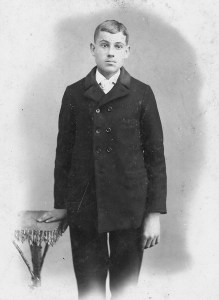
 He appears to have been sent away to school as a teen, first to Dr. John Vandeveer’s school and then to Lafayette College, both in Easton, Pennsylvania. A bit of map-stalking will show that Easton is due west of Bethlehem, NJ, where the family was located in the 1850 Census. Chester also benefited from having a famous and well placed brother: Bennett Van Syckel studied law at Princeton University, graduating in 1846 and he went on to serve as a justice on the NJ Supreme Court from 1869 to 1904. This may have been what made it possible for Chester Van Syckel to attend Princeton, where he earned a Bachelors degree in 1862.
 Shortly after graduation, Chester was admitted to the bar as an attorney and five years later in 1867 he was admitted as Counsellor at law.


 This week in #52ancestors, I successfully resolved the questionable legitimacy of
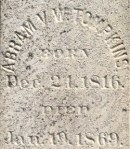 Abraham was buried 10 January 1869 at Freedom Plains Cemetery. Caroline Brown Tompkins appears in the 1870 census to reside in the state asylum in Oneida and is still there in 1875. She dies 1878 and is buried beside her husband.


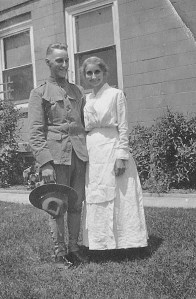
 I discovered Carrie M. Mather on one of my subject forays into my family tree. I was trying to find all the World War I service men and women, and so I was taking a hard look at anyone who was born between 1880 and 1900. As I plugged names into Fold3 and Ancestry, I was careful to just look at military service. I was able to document quite a few male veterans but I was shocked at the number of female veterans I had. Carrie is descended from a Mount family line firmly entrenched in New Jersey. And yet her story compels me.
 In December of 1917, she boarded the Espagne at the port of New York to sail to France to assist with YMCA Canteen work.
 Telling My Story