
Thinking to explore newly available records about the Prince family, I set about building out the family and antecedents of Jonathan Prince. I came across numerous references and documents and then was stunned to read that Jonathan’s great-great grandmother was one of the accused in the Salem witch trials of 1692!
Robert Prince was an early settler of the Massachusetts Bay colony, and owned land in Salem Village (Danvers, MA today). When he died in 1674 his children were all under age but his will mentions sons James and Joseph and daughter Elizabeth as well as his wife Sarah (ne. Warren). Sarah could not manage the farm on her own and so she purchased the contract for a “redemptioner” named Alexander Osburn (or Osburne) to help her work the farm. Unfortunately for her, she eventually married him. Apparently, it was not a happy marriage and later accounts paint a dismal picture of both physical and mental abuse. Sarah Osburn became depressed and took to her bed. She was accused by the young women of Salem as a witch and was brought before the court and questioned. Although she denied the testimony against her, she was jailed and transported to Boston where she died two months later.

Anyone wanting to read more can visit this online exhibit which reviews the available records of the witch trials http://salem.lib.virginia.edu/category/uph1wit.html.
Robert’s sons James and Joseph were able to reclaim their inheritance and prospered in Salem. James married a Sarah Rea and they had six children, of whom their fifth child was David Prince. David and wife Phebe Fuller (b. 1706) moved from Salem Village to Sutton where they raised five children. David died very early at the age of 35 years and guardianship records for sons Stephen and John show them placed with James Prince and John Fuller respectively.

Stephen Prince married Abigail Perkins (1736-1820) and they raised thirteen children in Sutton as it transitioned from a British colony to a town in America. Stephen appears to have fought for the colonies during the American Revolution but print resources are jumbled and further research is necessary to build out his service. At some point in the late 1780’s the family removed to the town of Oxford. Numerous printed sources state that Stephen died in either 1780 or 1800 but he appears in the 1810 census with his sons Stephen Jr. and David. Jonathan had already removed to Sturbridge. There are also several mix ups concerning Stephen Sr’s wife Abigail Perkins and Stephen Jr’s wife Abigail Pratt.

Jonathan Prince, born in Sutton, moved with the family to Oxford where he married Patty Vinton. Shortly before the 1809 birth of his daughter Juley, the family relocated to Sturbridge and from there to Orwell, Pennsylvania.

 Do you have a county boundary nemesis? I do, in the form of New Jersey. I have yet to come up with a one stop way to figure out where the Windsor townships are in any given year. Legally, I know that Windsor Township split into East and West Windsor on 9 February 1797 while these were in Middlesex County. The townships were incorporated in 1798 and their boundaries changed when Hightstown borough formed in 1853 and Washington Township formed in 1860.
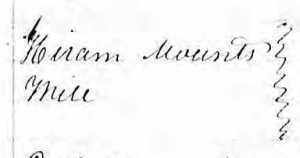 The three living children are mentioned in Hiram’s Monmouth County 1845 will and there is a clue there about how this Monmouth County family came to be in Mercer County. Hiram divides his land holdings between his two sons, mentioning that he leaves Thomas the “plantation or farm” in which he currently lives. I matched that with a house history I uncovered in doing Thomas H. Mount’s essay and Voila!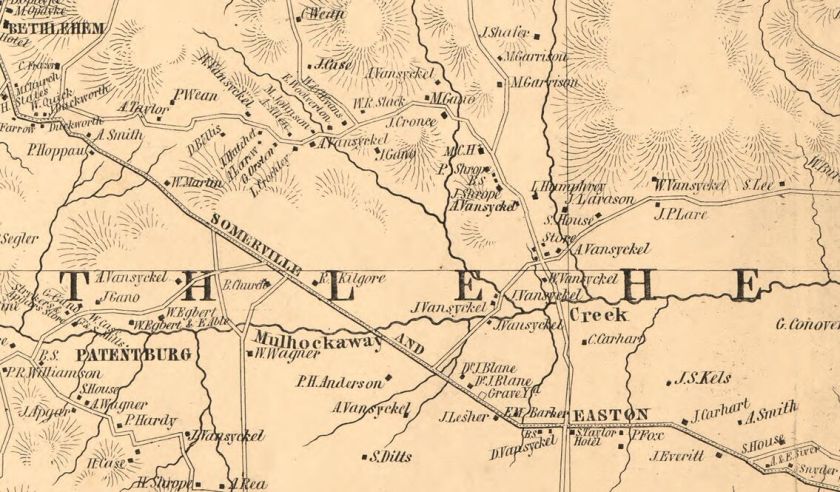

 This week in #52Ancestors I wanted to work on the Brown family, a branch that I discovered, in part due to the family bible digitized by another descendant. That bible gave me just enough information to go back to census and church records and allowed me to build out this biography. Along the way, I came across what I think may be 19th century vanity.


 John D. Brown died 20 March 1875, but I am not sure if this happened at La Grange or Poughkeepsie. He is buried in Freedom Plains Presbyterian Church, Pleasant Valley.

 I have to admit, after the DeWolfe media frenzy about that family’s discovery that they made their money in the slave trade, I was alarmed when I found that multiple generations of the Tompkins family had lived in Rhode Island during the height of the Atlantic slave trade. Even if they were not involved in shipping, all the ancillary trades that go into supporting the shipping industry are tied to that profit source as well. So for this week of #52ancestors I picked an ancestor whose life would have touched on this dark period in American history.
 Little Compton and the neighboring town of Tiverton were first established as part of Massachusetts in the middle of the 17th century. In 1673, the town was plotted and twenty-nine settlers made claims, most of them Puritans. Later in 1747, the state of Rhode Island formed and the towns became part of that. A Colonial Census was done at that time and Samuel is listed in Little Compton, New Port County.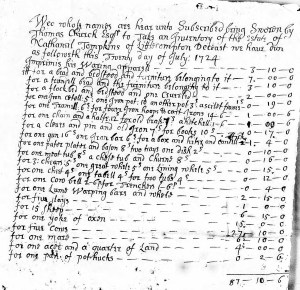


 This week of #52Ancestors lead me to Vincent Van Nest, whose birthday is 25 April 1837 and who joins the family tree by marrying Margaret Ann Mount, older sister to my direct ancestor Mary Jane Mount (1844-1917). The Van Nest surname can hide in records as Van Nest, VanNest and Vannest, making it a bit tricky to find them. Also I discovered this family marrying Mounts in many generations. But the really interesting discovery happened when I tried to document Vincent’s parents.


 Cornelius D. Vreeland was born in Paterson, New Jersey on 4 March 1813. At this time, Paterson was in Essex County but it eventually became Passaic County. Young Cornelius was duly baptized at the First Reformed Church in Totowa, a small community just outside of Paterson. On 29 September 1836 he married Rachel Beach and they settled on a farm in Wayne township. They six children: Josiah Pierson (1841-1895), Maria Mottear (1842-1844), Elizabeth Derrom (1846-1924), Adelia (1850-1893), Cornelius (1852-1854) and Jonathan Beach (1855-1911).
 Interestingly, Beach is left to file the articles of administration, which speak to the need for the estate to be inventoried. Although Passaic County has an online index, the case files themselves have not been put online, so a request for a paper copy has been made.
 Telling My Story