
This week in #52Ancestors I took the opportunity to put several people into context, as George Grant Tennant is one of the few Tennant children who lived to adulthood.
 George Grant Tennant was the son of Thomas and Hannah Cardiff Tennant, born 1 Feb 1869 in Jersey City. He was baptized at St. Mark’s Chapel, Jersey City. George was educated in the public schools, namely Public School No. 1 and later the High School, from which he graduated in 1888. He graduated from Columbia University Law School in 1891 and was admitted to the New Jersey bar in 1892 as an attorney and as a counselor in 1895. He went into practice with John W. Queen.
 George Tennant married Zora McBurney (1863 or 1869-1895) on 1 June 1893. She died shortly after the birth of their son Donald McBurney Tennant (5 June 1895-22 January 1896). Both mother and child are buried in Green-Wood Cemetery in Brooklyn.
George married again on 12 April 1898 in Jersey City to Anne Van Syckel daughter of Chester and Mary Jane Mount Van Syckel. Anne Van Syckel was born 23 Aug 1870 in Flemington, New Jersey and baptized in 1883 at Flemington Baptist Church. She attended Vassar College and graduated in 1893. We have wonderful photographs of her playing a part in a Greek play, which I have now learned was Antigone.


 George and Anne Tennant had three children: Katharine Vansyckel Tennant (1899-1972), George Grant Tennant Jr. (1900-1982), and Jean Cardiff Tennant (1905-1990).
George Tennant was a member of the New Jersey House of Assembly from 1900 to 1902. His candidate bio in the Jersey Journal in 1899 stated that he was one of the most popular young Democrats in the Ninth Ward. At that time he attended the First Presbyterian Church, where he taught Sunday School. A year later, when he ran again, the paper was a little less supportive, as an article appearing in the Jersey Journal of 1 November 1900 spent two columns shredding Tennant and everything he had stated in print that year. He served as the president of the Jersey City Board of Education from 1908 to 1913.
Tennant was a friend of Jersey City Mayor H. Otto Wittpenn and assisted in the nomination of Woodrow Wilson for President in 1912. In 1913, George Tennant was appointed a Common Pleas judge by Governor James F. Fielder, serving from 1913 to 1918. Towards the end of his lift he became a member of the Old Bergen Reformed Church and was active in the Everyman’s Bible Class there. He was also a 32nd degree Mason and a member of the Scottish Rite.
Anne Tennant was active in the Jersey City College Club and was a member of the Odd Volumes Club, a sort of social book club to which many of the Tompkins women also belonged. George and Anne vacationed in Dorset, Vermont.

Anne died at home (613 Bergen Ave.) on 9 March 1938 and is buried in Green-Wood Cemetery in Brooklyn. George died at Lea Haven, a nursing home in Madison, NJ while recovering from an appendectomy on 3 February 1948 and is also buried in Green-Wood.


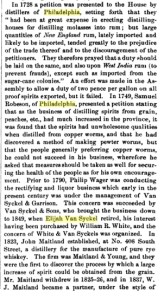 Elijah appears to have established his grocery and then expanded it to sell liquor. He then gave up the grocery business and solely sold wine and liquor. He appears in city directories and merchant listings fairly continuously from 1818 until 1850. During the 1830’s he was in business with John Garrison but in 1835 this is dissolved and Elijah continues on alone, eventually adding his sons to the concern. One curious discovery: in 1824, Elijah was granted relief from the US government because three hundred and fifty-two cases of sugar were destroyed in a fire in 1822, upon which $4217 in duties were due. Elijah apparently appealed for aid in paying the duties as the sugar had not been insured.
 He also appears to have been active in local politics as he has an unsuccessful bid for election to the Common Council in Philadelphia in 1827. In 1839 he is appointed to a committee to examine and report on the state of the Schuylkill Bank.
 I grew up hearing stories about George Cornell Prince. Unfortunately, I did not ask the right questions of the people who knew him and I am left with a life story with a few holes in it. Perhaps one of my cousins will read this #52ancestors essay and can help fill in the blanks.
 So this is the first mystery: why did they pull up roots in Bradford County and move down to New Jersey? Philip is born there as are Edwin and Kathryn but the family does not appear in either the federal 1900 census or the 1905 New Jersey census. And yet, in a 1955 Camden Courier-Post article, George C. Prince is credited with forming the Prince Concrete Company in 1905.

 Aaron Van Syckel inherited a sizable estate from his father totaling 240 acres, which he built into quite an empire. In 1800, he purchased a tavern owned by David Reynolds in Bethlehem township, which he made his home. There was also a store nearby which he ran with his son Aaron Jr. as well as a post office. The tavern is listed on both state and National Historic Registers and I remember as a child going to see the buildings at Van Syckel’s corner.
 Aaron Van Syckel was a member of the Bethlehem Presbyterian Church and helped that congregation erect a stone church in 1830. It is no longer standing but there is a marker noting the construction and, of course, the cemetery is still there.


 Telling My Story