
 This week in #52ancestors I celebrate the man who left New York for New Jersey and made it possible for me to spend every spring break of my childhood shopping at the Short Hills Mall. And the theme for Week 36 is “Work” which I am going to interpret as “creating the family business.” I still have wooden Smooth On crates in my house which are so useful for so many storage needs.
This is yet another story with a lot of questions, but here is what I have:
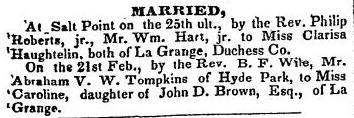
Samuel Dusenbury Tompkins was born 12 Dec 1838 in Hyde Park, NY. He was the oldest child of Abraham Van Wagenen (1816-1869) and Caroline Brown (1818-1878) Tompkins. They went on to have eight more children, which probably helped with the work on the small farm Abraham owned in Dutchess County. For several years I have been searching for corroboration of the marriage date of Abraham and Caroline. The family bible notes that the marriage occurred on 22 Feb 1839. This makes the date of birth of the first child in 1838 a bit sticky. Thank goodness for the New York State Historic Newspapers project! I found a marriage notice in the Poughkeepsie Eagle for 9 March 1838 which names all the right people and gives the marriage date as 21 Feb 1838.
Samuel’s obituary mentions that he came to Jersey City when he married Gettianna Vreeland, daughter of Nicholas and Elizabeth Van Riper Vreeland. They were married 2 January 1868 in Bergen, NJ at her parents’ residence by Rev. B. C. Taylor. The couple had seven children, five of whom lived to adulthood.
- Grace Elizabeth Tompkins (1869-1964)
- Vreeland Tompkins (1870-1956)
- Abraham Van Wagnen Tompkins (1870-1870)
- Samuel Edward Tompkins (1875-1876)
- James Haviland Tompkins (1877-1942)
- Emma Louise Tompkins (1881-1971)
- Harold Doremus Tompkins (1888-1951)
In fact, the couple lived with Nicholas Vreeland and family in Bergen for the first few years of their marriage. They are enumerated there in the 1870 Census and Samuel appears in Jersey City directories as early as 1872 with the occupation “storage.” This aligns with a newspaper article which describes the complete loss of a New York city warehouse in 1872, resulting in the loss of stored cotton, grain and tobacco. By 1876, Samuel is listed as a real estate broker, although the residence is still listed as Communipaw n Vreeland. In the 1880 Census, Samuel and family have been joined by brother James L Tompkins, down from Dutchess County, NY.
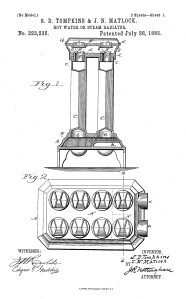 In 1895, Samuel founded the Smooth-On Manufacturing Company to manufacture a chemical iron compound by that name. I have always been told that Samuel was the businessman and backed the company with his own money and experience, while his son Vreeland was the chemist and the creator of Smooth-On. Evidence, however, indicates that he was involved in inventing and designing as early as 1885, as he was the one who filed for a patent for the design for a radiator in 1885 with John Matlock. And in 1905, his patent for a boiler patch states that he is the inventor. He is also listed in 1895 as the treasurer of the A. A. Griffins Iron Co. in Jersey City. Diverse holdings makes for good business.

Samuel Tompkins was active in the Bergen Reformed Church and was listed as deacon from 1912 to 1914. He was also a member of the Free and Accepted Masons Zeredatha Lodge No. 131. His grown children were active in Jersey City social events and he, as well as his daughters, entertained regularly according to the Jersey Journal.
Samuel D. Tompkins died at home on 1 January 1926. His funeral was held at his home, 533 Communipaw Ave. He was buried in the family plot of the burying ground opposite the Old Bergen Church. Later, due to the cemetery being demolished, the burials of Samuel and his wife Gettieanna were removed to Arlington Cemetery, in Kearny, NJ.
![Jones_Benjamin_W_business_Trenton_State_Gazette_1858-05-07_[2]](https://tellingmystory.blog/wp-content/uploads/2018/03/jones_benjamin_w_business_trenton_state_gazette_1858-05-07_2.png?w=300&h=265) I do not know much about Benjamin W. Jones’ business enterprises. In the 1850 Census, he is listed in Philadelphia as a merchant with $15,000 in real estate. He then appears in business with Richard Jones at Florence but that business dissolved in 1858. In the 1860 Census, the family is living near Richard Jones in Mansfield, Burlington County, New Jersey and his occupation is listed as founder. By 1870, Benjamin, Harriet and Ellen are living in Trenton, where his occupation is listed as none, with no real estate or personal property valued. However, Harriet does possess $10,000 in real estate and persona”l property valued at $25,000. In the 1880 Census, Benjamin is listed with Harriet and both children, and while his occupation is listed as travelling salesman, there is a check mark in the box marked “is the person sick or temporarily disabled so as to be unable to attend to ordinary business or duties.”
I do not know much about Benjamin W. Jones’ business enterprises. In the 1850 Census, he is listed in Philadelphia as a merchant with $15,000 in real estate. He then appears in business with Richard Jones at Florence but that business dissolved in 1858. In the 1860 Census, the family is living near Richard Jones in Mansfield, Burlington County, New Jersey and his occupation is listed as founder. By 1870, Benjamin, Harriet and Ellen are living in Trenton, where his occupation is listed as none, with no real estate or personal property valued. However, Harriet does possess $10,000 in real estate and persona”l property valued at $25,000. In the 1880 Census, Benjamin is listed with Harriet and both children, and while his occupation is listed as travelling salesman, there is a check mark in the box marked “is the person sick or temporarily disabled so as to be unable to attend to ordinary business or duties.”
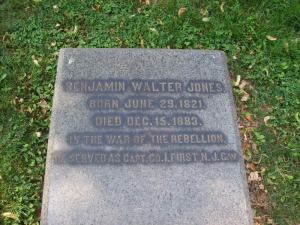 Benjamin Walter Jones died 15 December 1883 in Philadelphia and is buried at Laurel Hill Cemetery in Philadelphia. His death notice in the Philadelphia Inquirer notes that his brother hosted the funeral at his home at 1818 Delancey Place. He left no will, which is not a surprise as his wife Harriet appears to have owned everything.
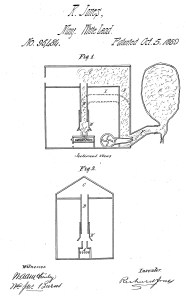 Although Richard appears to have gone to work early in the family foundry business at Hanover, NJ, he also seems to have been interested in diversifying the family holdings. He and his brother Samuel Howell Jones established and dissolved several businesses in Hanover, Florence and Trenton between 1845 and 1870. The pipes used in the Boston Water Works in 1847 came from Hanover Furnace. In 1850 Richard was a principle in the New Jersey Exploring and Mining Company. He established the New Jersey Zinc Paint Company, most likely as a result of his experiments with and eventual patents on zinc oxide extraction (1854 and 1869). Richard was definitely something of a chemical genius but I am not sure about his business expertise. The iron industry in the 19th century was a risky business. with many smaller operations failing due to pressures of the economy and production expenses.
 Telling My Story