
This week in #52ancestors I am faced once again with a woman, Emily Van Syckel Bonnell, who existed long enough to create six children and barely rates an honorable mention in her husband’s obituary. Can genealogists be feminists? Telling stories and giving names!
Emily may have lived a largely uneventful life but today she gets to be the star of her own blog post! Emily Van Syckel was born on 5 April 1832 in Union township, Hunterdon County, New Jersey. She was the eighth child of Aaron (Jr., 1793-1874) and Mary Bird (1799-1863) Van Syckel.
Like many of her generation, Emily’s life was recorded either as daughter or as wife. In 1850 she is living at home with her parents and the most surprising thing about that census record is that at 18 she is listed as attending school within the year. And two years later, on 16 June 1852, she married Alexander Bonnell. I can find very little about Alexander, other than that he was a feed and seed merchant. His obituary tells of his membership on the New York Produce exchange and his life as an exemplary citizen of Jersey City, NJ. I found traces of him in Newark and Bergen prior to Jersey City and I think he was in a part of Bergen that eventually just became Jersey City.
Emily and Alexander Bonnell had six children:
- Sarah Bird Bonnell (1853-1914)
- Catherine V. Bonnell (1855-1918)
- Alexander Bonnell Jr. (1858-1888)
- Frank Roe Bonnell (1860-1903)
- Mary Deborah Bonnell (1862-1917)
- Charles Van Syckel Bonnell (Feb 1864-Nov 1864)
 I don’t know whether complications from the birth of Charles lead to Emily’s death on 4 November 1864 but I think it likely there is a connection. Six children in eleven years in the mid 19th century would be a strain on anyone. She is buried in Bethlehem Baptist Cemetery in Pattenburg, NJ, along with Charles.
Emily died so young and with such small children at home, she probably did not get to make many friends in Jersey City. As for Alexander, barely a year went by before he married Sarah Dumont of Interlaken, NY on 11 October 1865. She traveled with Alexander when he went down to the pines in North Carolina and died there as a result of a miscarriage 25 January 1878. By the 1880 census however, Alexander has married a third time to Sarah Jane “Jennie” Douglass, with whom he had a daughter Edith Bonnell. Alexander died 30 September 1886 in Jersey City but is buried back with his roots in Hunterdon County at Bethlehem Cemetery in Union, NJ.
This is often how it works: you start trying to document the life of a woman and end up finding stuff on the men.
 George Grant Tennant was the son of
  George Tennant married Zora McBurney (1863 or 1869-1895) on 1 June 1893. She died shortly after the birth of their son Donald McBurney Tennant (5 June 1895-22 January 1896). Both mother and child are buried in Green-Wood Cemetery in Brooklyn.


 George and Anne Tennant had three children:

 This week in #52ancestors I celebrate the man who left New York for New Jersey and made it possible for me to spend every spring break of my childhood shopping at the Short Hills Mall. And the theme for Week 36 is “Work” which I am going to interpret as “creating the family business.” I still have wooden Smooth On crates in my house which are so useful for so many storage needs.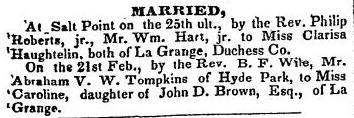
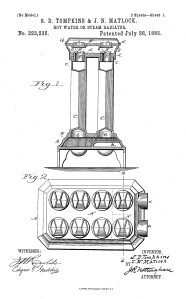 In 1895, Samuel founded the Smooth-On Manufacturing Company to manufacture a chemical iron compound by that name. I have always been told that Samuel was the businessman and backed the company with his own money and experience, while his son Vreeland was the chemist and the creator of Smooth-On. Evidence, however, indicates that he was involved in inventing and designing as early as 1885, as he was the one who filed for a patent for the design for a radiator in 1885 with John Matlock. And in 1905, his patent for a boiler patch states that he is the inventor. He is also listed in 1895 as the treasurer of the A. A. Griffins Iron Co. in Jersey City. Diverse holdings makes for good business.

 Vreeland was educated at Public School No. 12 and the Hasbrouck Institute, in Jersey City. He graduated from Rutgers University in 1893 and was a member of Delta Phi fraternity. After graduation he was employed as a chemist at Standard Oil Co., Bergen Port Works. In 1895, he founded the Smooth-On Manufacturing Company, with his father serving as President and himself as lead chemist. Vreeland invented the product Smooth-On was an iron cement compound. I have a childhood memory of bookcases in our house and Louise Tompkins’ house which were made from the shipping containers from Smooth-On. After Samuel D. Tompkins’ death in 1926, Vreeland assumed the presidency until 1953 and then in retirement served as chairman of the board.
 I was fascinated to discover that Vreeland Tompkins’ obituary described him as a life-long Episcopalian, first at St. Paul’s Episcopal Church in Jersey City, then at Calvary Church in Summit and finally at St. Paul’s in Chatham, New Jersey. As one, myself, this gives me an extra connection to this interesting man.




 Telling My Story