
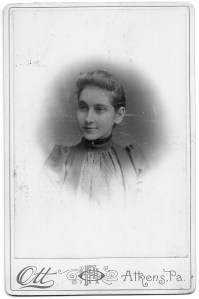
This week in #52ancestors #52familyphotographs Minnie Arabella Hine takes center stage as a good example of incorrect information in a marriage record. Corroborate, double check and check again! Minnie was my great grandmother and figuring out her real mother set me a merry chase.
Minnie was born on 1 August 1866 in Orwell, Pennsylvania. Her father’s name was James Edwin Hine. Her mother’s name was Catherine Tyrrel or Terrell. She was the second of two daughters of this couple. Martha or Mattie, her older sister, clearly lists her mother on her marriage record as Catherine but Minnie lists her mother as A. E. Hine. James Hine married Ann E. Phillips in 1870 when Minnie was about 4, and she may not have had any memories of her birth mother. Luckily, I happen to have James’ bible which records Catherine’s death and his remarriage.
Minnie married George Cornell Prince on 9 July 1894 up in Bradford County. George was living in Philadelphia at the time, employed as a stenographer with the Philadelphia Typewriter Exchange. I am not sure when he went down to Philadelphia, but he appears in city directories from 1895 to 1904. The family lived in Philadelphia until 1897, when the directory notes that his home is in Rosedale, New Jersey.
Minnie and George Prince had four children, the first born in Philadelphia and the rest in Camden:
- George Raymond Prince (1895-1939)
- Philip Hine Prince (1896-1974)
- Edwin Everett Prince (1898-1899)
- Kathryn Marie Prince (1903-1993)

I don’t know much about her life in Camden. I know she went home to Bradford County occasionally as her visits are tracked in the local paper. Her father and step-mother had one son, Arthur Hine and she appears to have visited him and her sister.
Minnie Prince died at home on 23 June 1931 and is buried in Bethel Memorial Park in Pennsauken, NJ. Her obituary mentions her children and grandchildren but does not highlight any other activities.

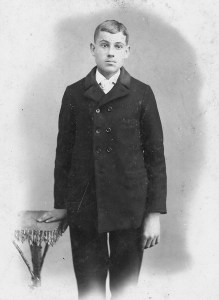
 Although the obituary made it sound like a recent move, evidence in the 1910-1930 censuses show that the Jones family was in Camden as early as 1910. At that time he was a steam car engineer, possibly for the Pennsylvania/NJ Railroad. Their home is listed as 136 Dudley St., Camden. By 1915, the family has moved to 309 N. 40th St., and in this census Arthur is listed as a “portable engineer,” a job title which intrigued me. According to the International Steam Engineer of 1914, this is “one who operates a boiler or machine which directly furnishes or transmits power for any machine, appliance or apparatus used on or in connection with building operations, excavations or construction work, but does not include an operator of a drill.” A union newsletter gave a much more understandable description: “The steam or power shovel was first invented by William T. Otis in 1839, but it did not see extensive use until after the American Civil War, when it was developed as a railway workhorse. The men who operated the shovels were known as portable engineers, to distinguish them from the stationary engineers.” Pretty cool to think of Arthur Jones as playing the role of Mike Mulligan in my favorite children’s book Mike Mulligan and his steam shovel.
 My essay this week in #52ancestors concerns my grandfather Barclay Gibbs Jones. I never met this man because he died before even my father was born. His legacy lives on, however, in both his name and his deep-set eyes. As I look through family photographs of the wedding trip taken by Barclay and Kathryn Prince Jones, I see aspects of my father, brother and nephews in the turn of his head, his smile and his eyes.


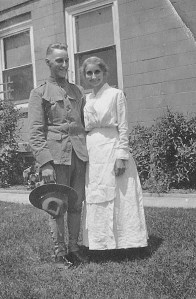


 I grew up hearing stories about George Cornell Prince. Unfortunately, I did not ask the right questions of the people who knew him and I am left with a life story with a few holes in it. Perhaps one of my cousins will read this #52ancestors essay and can help fill in the blanks.
 So this is the first mystery: why did they pull up roots in Bradford County and move down to New Jersey? Philip is born there as are Edwin and Kathryn but the family does not appear in either the federal 1900 census or the 1905 New Jersey census. And yet, in a 1955 Camden Courier-Post article, George C. Prince is credited with forming the Prince Concrete Company in 1905.

 Telling My Story