
 My essay this week in #52ancestors concerns my grandfather Barclay Gibbs Jones. I never met this man because he died before even my father was born. His legacy lives on, however, in both his name and his deep-set eyes. As I look through family photographs of the wedding trip taken by Barclay and Kathryn Prince Jones, I see aspects of my father, brother and nephews in the turn of his head, his smile and his eyes.
Barclay Gibbs Jones was born on 30 May 1901 to Arthur Wells and Anna Mary Wells Jones. He was their only child, which makes his early death all the more tragic. The family were active members of the Rosedale Baptist Church and Barclay appears often in the newspapers organizing young people’s events for the church, as well as other social gatherings. And young Kathryn Prince is present at most if not all of these parties. I do remember my father saying that my grandmother loved to go about socially and that as a youngster he was often dragged about as she did her visiting.

Barclay and Kathryn were married on 25 June 1924 at the home of George C. Prince (212 N. 38th Street, Rosedale. The newspaper articles describe in detail the quiet ceremony surrounded by snapdragons and carnations. The bride wore white Canton crepe with stockings and shoes to match. The honeymoon was in Niagara Falls, after which the bride and groom returned to 212 N. 38th St. while they waited for their own home on Scoville Ave. in Hillcrest to be finished. I don’t know if they ever even lived there, as Barclay died on Christmas eve.
I found among the family archives a little photo album that Kathryn Prince Jones made documenting their short life together. The wedding pictures appear to have been taken outside 212 N. 38th St. and, in particular show off some stunning concrete porch columns. I wonder if these are examples of the work Prince Concrete did, as I know they did a lot of porches and garages.


Barclay worked at Prince Concrete Co. and was apparently carrying cement blocks when he tripped over an oil can, the tip of which pierced his body. I remember my father once telling me that the injury developed into blood poisoning which was what caused his death. The final indignity of it all was to have his name so grossly misspelled in the paper that it took me ages to find it.
Barclay’s funeral took place in the same room he was married in seven months previously and he is buried under a simple marker at Bethel Memorial Park, Pennsauken.


 I did find George in the 1900 Census, living alone in the town of Hampton, NY. This is right across the Vermont border from Poultney where a newspaper search shows that George has acquired a business. A little more sleuthing unearths the news that 1910 marked the return of the family to New Jersey from Vermont. In focusing on that I found that Mary was born in 1901 in Vermont according to her death certificate (dated 1957 in Pennsylvania from a brain tumor).
 And the newspaper is one of the best sources of information on Lillie, other than the Census. Mary was apparently active in the Burlington County community, attending her friends weddings and holding parties. Lillie is often noted as attending as well. In the 1940 Census their household consists of Lillie, Mary and a boarder named William Sullivan and in 1941 he married Mary.


 Samuel married twice. He married Lydia H. Bishop (1828-1860) on 7 March 1849 but they had no children. They are enumerated in Philadelphia in the 1850 Census along with several of Samuel’s siblings: Mary B Jones Tobey and husband Samuel, Harriet Jones. Samuel is listed with the occupation of merchant. By 1860, the family has relocated to Burlington County, where Samuel and Lydia maintain a household that contains most of her family: Nathanial Bishop (cultivator of cranberries) and Harriet Bishop. Samuel’s occupation is “manufacturing” and his personal worth is $50,000.
 Then he married Eliza Catherine Jacob (1835-1864) on 1 May 1862. They had one child, a son named Samuel Howell Jones (1862-1894). Sadly, “Kate” died in 1864. I do not know what took him to Kentucky but I strongly suspect that it might have something to do with all the Louisville & Nashville Railroad stock in his estate accounts. Either Samuel was an investor or he was diversifying the family assets out of iron pipes to iron rails. A review of the family archive at the Historical Society of Pennsylvania will be necessary to complete this chapter.


 This week on #52ancestors I am writing about Mary “Stella May” Jones. She was the ninth child of Benjamin (1833-1896) and
 They had a little girl in 1909 named Mae Ayres, who died shortly after birth and is buried in the Methodist Cemetery in Pemberton. They do not, however, appear to have been active in the Methodist Church.
![Jones_Benjamin_W_business_Trenton_State_Gazette_1858-05-07_[2]](https://tellingmystory.blog/wp-content/uploads/2018/03/jones_benjamin_w_business_trenton_state_gazette_1858-05-07_2.png?w=300&h=265) I do not know much about Benjamin W. Jones’ business enterprises. In the 1850 Census, he is listed in Philadelphia as a merchant with $15,000 in real estate. He then appears in business with Richard Jones at Florence but that business dissolved in 1858. In the 1860 Census, the family is living near Richard Jones in Mansfield, Burlington County, New Jersey and his occupation is listed as founder. By 1870, Benjamin, Harriet and Ellen are living in Trenton, where his occupation is listed as none, with no real estate or personal property valued. However, Harriet does possess $10,000 in real estate and persona”l property valued at $25,000. In the 1880 Census, Benjamin is listed with Harriet and both children, and while his occupation is listed as travelling salesman, there is a check mark in the box marked “is the person sick or temporarily disabled so as to be unable to attend to ordinary business or duties.”
I do not know much about Benjamin W. Jones’ business enterprises. In the 1850 Census, he is listed in Philadelphia as a merchant with $15,000 in real estate. He then appears in business with Richard Jones at Florence but that business dissolved in 1858. In the 1860 Census, the family is living near Richard Jones in Mansfield, Burlington County, New Jersey and his occupation is listed as founder. By 1870, Benjamin, Harriet and Ellen are living in Trenton, where his occupation is listed as none, with no real estate or personal property valued. However, Harriet does possess $10,000 in real estate and persona”l property valued at $25,000. In the 1880 Census, Benjamin is listed with Harriet and both children, and while his occupation is listed as travelling salesman, there is a check mark in the box marked “is the person sick or temporarily disabled so as to be unable to attend to ordinary business or duties.”
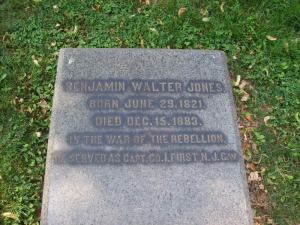 Benjamin Walter Jones died 15 December 1883 in Philadelphia and is buried at Laurel Hill Cemetery in Philadelphia. His death notice in the Philadelphia Inquirer notes that his brother hosted the funeral at his home at 1818 Delancey Place. He left no will, which is not a surprise as his wife Harriet appears to have owned everything.
 This week in #52Ancestors I’d like to finish the other half of the
  The Gibbs family appears in Quaker meeting records moving from Upper Springfield meeting to Mount Holly meeting in 1817, but the next time I find them is in 1835, when the entire family is being “disowned” by the Mount Holly meeting. This may be due to the fact that Susan and her sisters seem to have each married outside the faith.
  The marriage for Richard Jones and Susan Gibbs was performed by a justice of the peace in Burlington County on 13 June 1833.
 While I know that Richard Jones lived at Mary Ann Furnace later in the 1840’s I do not know if this is where Susan E. Gibbs lived with him during their short marriage. Because she entered and left the family history between two censuses and because her two boys had so little time with her, it is hard to find details.
 This essay was originally published on 1 May 2018. It contained erroneous information and so I have updated and corrected it as of 2 June 2018.

 Joseph Roach is listed in records as a merchant, but I can find little to document what and where he did business.

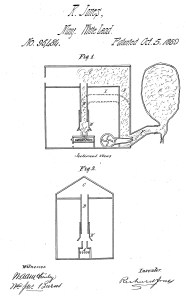 Although Richard appears to have gone to work early in the family foundry business at Hanover, NJ, he also seems to have been interested in diversifying the family holdings. He and his brother Samuel Howell Jones established and dissolved several businesses in Hanover, Florence and Trenton between 1845 and 1870. The pipes used in the Boston Water Works in 1847 came from Hanover Furnace. In 1850 Richard was a principle in the New Jersey Exploring and Mining Company. He established the New Jersey Zinc Paint Company, most likely as a result of his experiments with and eventual patents on zinc oxide extraction (1854 and 1869). Richard was definitely something of a chemical genius but I am not sure about his business expertise. The iron industry in the 19th century was a risky business. with many smaller operations failing due to pressures of the economy and production expenses.
 I chose Elizabeth for my second #52Ancestors because I had life dates for her but little else and she had what for the Jones family is an unusual name. I thought I would learn all there was to know just by stringing her census records together, since she apparently never married. Little did I know.
 Elizabeth trained as a nurse at Bryn Mawr Hospital, graduating in 1912 and working in New York, Missouri and Pennsylvania. She served during World War I at the American Red Cross Military Hospital in Paris, France. There is great information about this in both her passport application, which contains letters from her employers vouching for her credentials, but also in her Veterans Compensation application, which details her training and work history. Of note is also the article that appeared in the Brooklyn Daily Eagle welcoming her home after the war.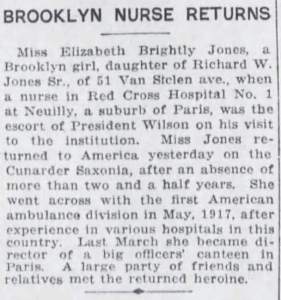
 Telling My Story