
This week in #52Ancestors I took the opportunity to put several people into context, as George Grant Tennant is one of the few Tennant children who lived to adulthood.
 George Grant Tennant was the son of Thomas and Hannah Cardiff Tennant, born 1 Feb 1869 in Jersey City. He was baptized at St. Mark’s Chapel, Jersey City. George was educated in the public schools, namely Public School No. 1 and later the High School, from which he graduated in 1888. He graduated from Columbia University Law School in 1891 and was admitted to the New Jersey bar in 1892 as an attorney and as a counselor in 1895. He went into practice with John W. Queen.
 George Tennant married Zora McBurney (1863 or 1869-1895) on 1 June 1893. She died shortly after the birth of their son Donald McBurney Tennant (5 June 1895-22 January 1896). Both mother and child are buried in Green-Wood Cemetery in Brooklyn.
George married again on 12 April 1898 in Jersey City to Anne Van Syckel daughter of Chester and Mary Jane Mount Van Syckel. Anne Van Syckel was born 23 Aug 1870 in Flemington, New Jersey and baptized in 1883 at Flemington Baptist Church. She attended Vassar College and graduated in 1893. We have wonderful photographs of her playing a part in a Greek play, which I have now learned was Antigone.


 George and Anne Tennant had three children: Katharine Vansyckel Tennant (1899-1972), George Grant Tennant Jr. (1900-1982), and Jean Cardiff Tennant (1905-1990).
George Tennant was a member of the New Jersey House of Assembly from 1900 to 1902. His candidate bio in the Jersey Journal in 1899 stated that he was one of the most popular young Democrats in the Ninth Ward. At that time he attended the First Presbyterian Church, where he taught Sunday School. A year later, when he ran again, the paper was a little less supportive, as an article appearing in the Jersey Journal of 1 November 1900 spent two columns shredding Tennant and everything he had stated in print that year. He served as the president of the Jersey City Board of Education from 1908 to 1913.
Tennant was a friend of Jersey City Mayor H. Otto Wittpenn and assisted in the nomination of Woodrow Wilson for President in 1912. In 1913, George Tennant was appointed a Common Pleas judge by Governor James F. Fielder, serving from 1913 to 1918. Towards the end of his lift he became a member of the Old Bergen Reformed Church and was active in the Everyman’s Bible Class there. He was also a 32nd degree Mason and a member of the Scottish Rite.
Anne Tennant was active in the Jersey City College Club and was a member of the Odd Volumes Club, a sort of social book club to which many of the Tompkins women also belonged. George and Anne vacationed in Dorset, Vermont.

Anne died at home (613 Bergen Ave.) on 9 March 1938 and is buried in Green-Wood Cemetery in Brooklyn. George died at Lea Haven, a nursing home in Madison, NJ while recovering from an appendectomy on 3 February 1948 and is also buried in Green-Wood.


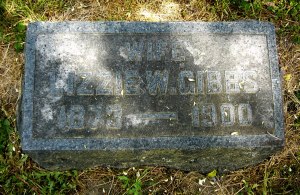 His sister Mattie J. Gibbs was born in 1892 but died in 1919 and his brother Elton Russell was born in 1894 but died in 1917. Their mother, Elizabeth “Lizzie” Jones Gibbs died in 1900.
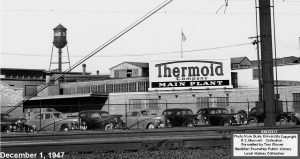 Francis eventually settled in Trenton, NJ where he worked for a company called Thermoid, which made rubber brake pads. The children all appear to have come of age in Hamilton township.
 When I started this year of #52Ancestors I focused on the birthdays, hoping it would give me some way to focus on who to write about. I only had on person with my birthday in common and that was me! Now, after 9 months of research and writing, I find voila! that I have three relatives in common.
 This week in #52ancestors I celebrate the man who left New York for New Jersey and made it possible for me to spend every spring break of my childhood shopping at the Short Hills Mall. And the theme for Week 36 is “Work” which I am going to interpret as “creating the family business.” I still have wooden Smooth On crates in my house which are so useful for so many storage needs.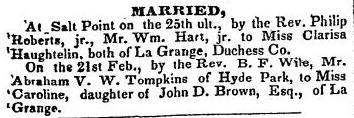
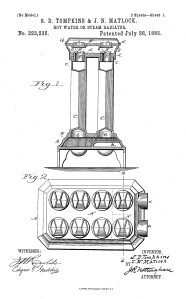 In 1895, Samuel founded the Smooth-On Manufacturing Company to manufacture a chemical iron compound by that name. I have always been told that Samuel was the businessman and backed the company with his own money and experience, while his son Vreeland was the chemist and the creator of Smooth-On. Evidence, however, indicates that he was involved in inventing and designing as early as 1885, as he was the one who filed for a patent for the design for a radiator in 1885 with John Matlock. And in 1905, his patent for a boiler patch states that he is the inventor. He is also listed in 1895 as the treasurer of the A. A. Griffins Iron Co. in Jersey City. Diverse holdings makes for good business.
 Telling My Story