
 This week in #52Ancestors I wanted to work on the Brown family, a branch that I discovered, in part due to the family bible digitized by another descendant. That bible gave me just enough information to go back to census and church records and allowed me to build out this biography. Along the way, I came across what I think may be 19th century vanity.
John Dusenbury Brown was born 26 August 1788, one of four children born to John (1760-1836) and Jane Dusenbury (1770-1845) Brown: William Henry Brown (?-1881), Sarah Brown (1785-1807), John D. Brown (1788-1875), and Charles I. Brown (1790-1860).
Although the name John D. Brown appears in numerous military and militia records, I do not believe that this John served in any military unit. On 24 July 1812, he married Mary “Polly” Sleght at the First Presbyterian Church, Pleasant Valley, NY. They had six children together:
- John Sleght Brown (1813-1893)
- Caroline Brown (1818-1878)
- Martha Jane Brown (1819-1911)
- Eliza Brown (1821-1875)
- Ann Brown (twin 1825-1928)
- Rachel Brown (twin 1825-1911)
In 1827, John D. Brown along with eight other men established the Presbyterian Church of Freedom Plains. He remained active in this congregation until his death and is buried in the church burial ground.
In 1850, John D. Brown, age 62, is enumerated in LaGrange NY with Mary age 62, John S. age 36, Jane, age 26 and Eliza age 24. I think John S. is mislocated because his wife Fanny and daughter Mary E are next door. Jane and Eliza have the correct ages here but not on the next two Census.
In 1860, John Brown age 71, appears in the Census as a Farmer on $21,000 worth of real estate. He is living with Jane age 26 and Eliza, age 25. Living next door is John S. Brown with wife Frances, children Mary E. 10, Ruth 9, and George 7. And yes, I too wondered how Jane and Eliza could be the same age they had been ten years before. But wait, there’s more!

An 1862 deed shows that John D. sold the farm to his son in 1862 with the condition that he could live there until the end of his life, profiting from the produce and livestock raised there.

John D. Brown married for the second time on 31 January 1865 to Hannah Maria Van Dyne (1804-1874), herself a widow of James Dates. In the 1865 NY census, taken on 7 June 1865, John and Hannah (age 56) and his two daughters Martha Jane (46) and Eliza (44) are living with John S. Brown Jr. in La Grange. However, five years later in the 1870 US Census, John D. Brown appeared living in LaGrange with wife Hannah and two young women Jane, aged 26 and Eliza aged 24! I know it is the right family because he is living next to John Brown age 50 who with wife Fanny is raising Mary, Ruth, George and Nellie. But how did his two unmarried daughters suddenly lose 25 years off their lives? It’s a miracle!

31 Jan 1865 m. Hannah Maria Van Dyne b. 11 June 1804 to Daughter of Garret and Maria (Montfoort) Van Dyne Hannah was the widow of James Dates. whom she married on 18 Jan 1832. She died 5 Aug 1874
 John D. Brown died 20 March 1875, but I am not sure if this happened at La Grange or Poughkeepsie. He is buried in Freedom Plains Presbyterian Church, Pleasant Valley.
In his will, written on 10 August 1874, he makes bequests to each of his children, but not to his second wife as she died 5 August 1874. Clearly this is a new will but it has several interesting points: one must be careful not to read between the lines but I would give much to be a bug on the wall of his lawyer’s office during that discussion! He leaves $1500 to Martha Jane, Eliza, Anne Brown Haviland and Rachel Brown Velie. A condition then states that if there is not enough to pay these amounts, then what there is is to be divided evenly amongst these four. Then he states that if there is anything left over it is to be divided between these four and Caroline Brown Tompkins. He then appoints his son in law, James Haviland and his grandson Samuel D. Tompkins executors.


I understand why John S. Brown is not mentioned, as the farm and all that property have already been sold to John S. Brown. But why leave Caroline so little? Was the relationship between the two broken or was there perhaps an earlier transaction? This is an area where more research needs to happen!
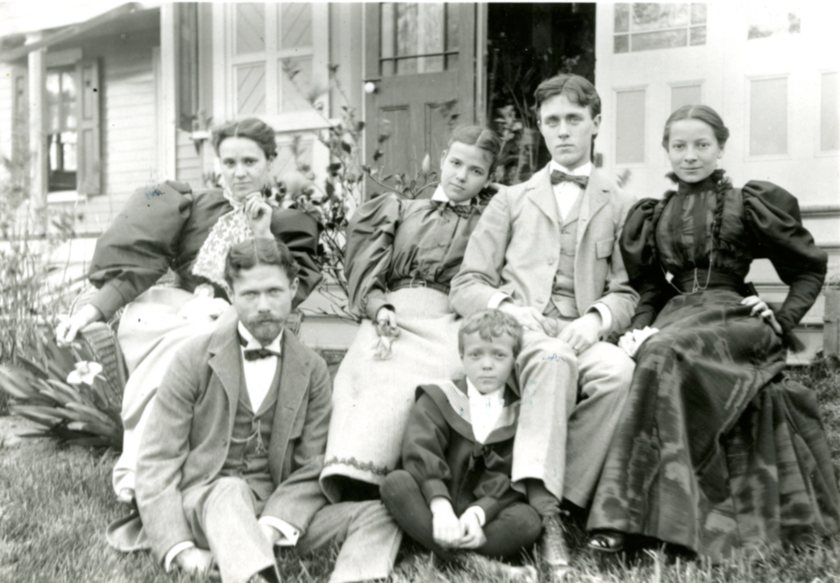

 Harold and Katharine Tompkins had three children: Anne Van Syckel (1923-1994), Mary Vreeland (1925- ) and Louise (1928-). By the 1930 Census, they are living at 132 Bentley Ave., close to family but on their own. Shortly after 1940, the entire family moved to Summit, New Jersey to a large house at 160 Oakridge Avenue. Many adventures occurred in this house, but I only knew about the house Granny moved into after he died, on Valley View Rd.
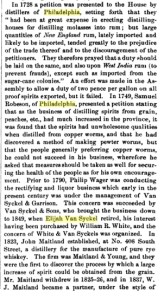 Elijah appears to have established his grocery and then expanded it to sell liquor. He then gave up the grocery business and solely sold wine and liquor. He appears in city directories and merchant listings fairly continuously from 1818 until 1850. During the 1830’s he was in business with John Garrison but in 1835 this is dissolved and Elijah continues on alone, eventually adding his sons to the concern. One curious discovery: in 1824, Elijah was granted relief from the US government because three hundred and fifty-two cases of sugar were destroyed in a fire in 1822, upon which $4217 in duties were due. Elijah apparently appealed for aid in paying the duties as the sugar had not been insured.
 He also appears to have been active in local politics as he has an unsuccessful bid for election to the Common Council in Philadelphia in 1827. In 1839 he is appointed to a committee to examine and report on the state of the Schuylkill Bank.


 I did find George in the 1900 Census, living alone in the town of Hampton, NY. This is right across the Vermont border from Poultney where a newspaper search shows that George has acquired a business. A little more sleuthing unearths the news that 1910 marked the return of the family to New Jersey from Vermont. In focusing on that I found that Mary was born in 1901 in Vermont according to her death certificate (dated 1957 in Pennsylvania from a brain tumor).
 And the newspaper is one of the best sources of information on Lillie, other than the Census. Mary was apparently active in the Burlington County community, attending her friends weddings and holding parties. Lillie is often noted as attending as well. In the 1940 Census their household consists of Lillie, Mary and a boarder named William Sullivan and in 1941 he married Mary.


 Telling My Story