
This week in #52ancestors I am simply trying to fill in a few blanks. I know I don’t have the full story, but I may never have the full story on this family. I have branches of my family tree that frustrate me, some challenge me, some just irritate me. The Vreelands exhaust me. There are so many of them and they all have the same first and last names and no one cares about the women, beyond whom they marry and whether there are male children. Okay, I know, cry me a river already.
The Vreelands arrive in the area now known as Jersey City, Hoboken and Bayonne in the 17th century. They bring their talent for farming and their strong business sense and their shear fecundity. Each direct ancestor in my line has at least ten children, although the rate of infant mortality is astonishing. I think this is one of the reasons that the same names are used over and over.
My great, great, grandfather Nicholas Vreeland (1789-1873) had nine such brothers and sisters. It is the next youngest, Daniel Vreeland, that I write about today.
Daniel Vreeland was born on 27 February 1791 in Jersey City to Michael (1758-1825) and Geertje Sickles (d. 1815) Vreeland. Of course, it wasn’t Jersey City then, but Bergen, which was part of Bergen County. On 23 January 1813, Daniel married Cornelia Newkirk. They had seven children, all of whom were born in Bergen: Jane (1813-1895), Michael D. Vreeland (1817-1893), Aaron N. (1819-1901), Gertrude Sickles (1822-1909), Cornelius V. R. (1825-1894), Nicholas D. (1828-?) and Daniel S. (1831-?).
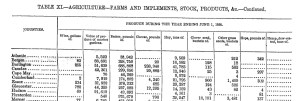
I have found the family in each Census since 1830, simple farmers in a large farming community. Unfortunately, because I have been unable to look at an agricultural census for New Jersey that lists individual farms, I have had to rely on statistical data like the 1850 and 1860 analyses of agricultural produce.

This, and the value of the family farm in 1860, $25,000 in real estate, lead me to believe that the farm was productive. If it was part of the Vreeland celery farms collective, I do not know, but these seem to have been well respected.
Daniel Vreeland died on 22 August 1867 and the funeral was held at the home of his grandson, William H. Speer, who was the son-in-law of Daniel’s oldest daughter Jane. Daniel left a will, which was quite helpful in spelling out his children’s marital status and favor in his sight. His wife Cornelia was to receive a money through a trust administered by their oldest son Michael. The first five children receive equal shares outright. Daniel S. Vreeland is to receive one share in trust to be distributed “from time to time.” One share was to be held in trust for the “use and benefit of the children of Nicholas D. Vreeland the net income thereof to be paid to them from time to time according to the discretion of my said executors.”

Nicholas D. and Daniel S. Vreeland have been hard to track through public records, but both seem to have had trouble maintaining themselves and their families. This may be the reason they are excluded from a direct legacy in the will. Nicholas appears to have fought in the Civil War in the 22nd Regiment, NJ Volunteers. He is hard to track in the Census but when he is listed his occupation is carpenter and he is enumerated within another family household. He appears in newspaper entries as running a public house which has a contentious relationship with law enforcement. He may appear in city directories as a garden farm laborer. He and his wife Catherine are mentioned occasionally due to very public marital problems. Daniel is also enumerated with family with an occupation of wheelwright but he also appears in newspapers on drunk and disorderly reports. He also may appear in city directories as a gardener. It is something to follow up on but I have seen enough Civil War veteran stories to think that these two might be suffering from what we now think of as PTSD. At the very least, they do not seem to have come home and settled back happily on the farm.
Cornelia followed her husband in death on 30 March 1870, and again, the funeral is from the home of William H. Speer. Both Cornelia and Daniel are buried in the Old Bergen churchyard in Jersey City. It is possible that Nicholas and Daniel are buried nearby but more information is needed to make that certain. Always more to do!

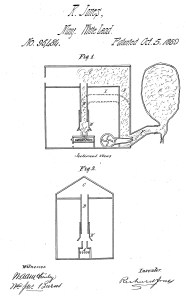 Although Richard appears to have gone to work early in the family foundry business at Hanover, NJ, he also seems to have been interested in diversifying the family holdings. He and his brother Samuel Howell Jones established and dissolved several businesses in Hanover, Florence and Trenton between 1845 and 1870. The pipes used in the Boston Water Works in 1847 came from Hanover Furnace. In 1850 Richard was a principle in the New Jersey Exploring and Mining Company. He established the New Jersey Zinc Paint Company, most likely as a result of his experiments with and eventual patents on zinc oxide extraction (1854 and 1869). Richard was definitely something of a chemical genius but I am not sure about his business expertise. The iron industry in the 19th century was a risky business. with many smaller operations failing due to pressures of the economy and production expenses.
 Katharine (with an A, thank you) VanSyckel Tennant was the first child born to Anne Vansyckel and George Grant Tennant. She was born 15 February 1899 in Jersey City where her father and mother lead a fairly high profile life. George Tennant was a lawyer, judge and member of the school board. Their social life is tracked in the Jersey Journal quite regularly.
 Katharine was soon joined by a brother George Grant Jr. (1900-1982) and a sister Jean Cardiff Tennant (1905-1990). She and her siblings attended Lincoln High School, which their father was instrumental in establishing. Katharine went on to attend Vassar College, graduating with the class of 1920. After college she met and married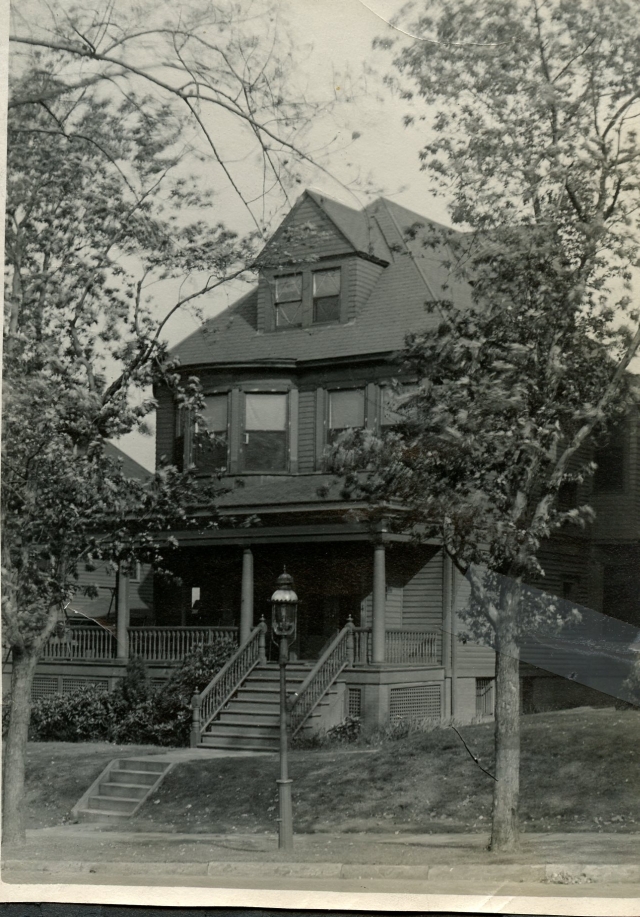
 Telling My Story